Tuesday, 23 July 2019

Generator Working Again - at last

Following the failure of the Mastervolt genset during our Scottish trip, when we returned to base I set about further investigating the problem.

The generator had worked faultlessly until that fateful day when it fired up and then stopped, pumping what I thought at the time was smoke into the engine room. My preliminary investigation found the insulation on the top of the DDC (Digital Diesel Control) box - the electrical gubbins that controls the generator - had partially melted but I could see no other signs of damage or what might have caused the problem. Access to the LHS of the generator is tight and the sound shield further restricts access. However, there is a panel in the third cabin which allows sight of that side of the genset. On removal, this is what I saw:
In the centre of the picture you can just make out where the exhaust elbow has come away from the exhaust manifold. The sound shield, on the right, is resting again the wall of the engine room and needed to be removed; however, the frame that holds the shield in place prevented the shield's removal.
This is a view from the top of the generator looking down on the detached exhaust elbow. In order to gain better access I removed the front and top of the sound shield frame which facilitated full removal of the sound shield. Result: much better access. I also removed the engine bay vent ducting - a large flexible pipe that sits above the generator - and the expansion tank. Access was now good and the offending parts could readily be removed.
It transpired that the 4 studs that should have been attached to the exhaust manifold had pulled out of the alloy flange. It appeared they had only been inserted to the depth of 3 screw threads and, over time, as corrosion took its toll the alloy of the manifold could no longer support the elbow. The local marine engineers milled the flange flat to provide a suitable surface for the gasket and fitted new studs. The result is shown below.
Unfortunately, this work was not completed before the departure date for our trip to Holland (blog to follow) so once again I set off without a generator. The Dutch still have Mastervolt dealerships whereas the UK doesn't. Legacy equipment is now supported by Fisher Panda and trying to get someone local who was knowledgeable about the generator was becoming irksome. Although I could see no visual damage to the wiring I asked some Mastervolt engineers to look over the generator whilst we were in Amsterdam. What I had feared was smoke resulting from burnt wiring turned out to be a mixture of exhaust gas and the molten DDC insulation.  The Mastervolt folks confirmed this and gave the generator a clean bill of health. Or at least as best they could without seeing it run! On return to the UK, the now renovated parts were replaced and it was time to give it a test run. 
All renovated and back together
The generator fired up without hesitation but the output voltage, at 204V, was lower than the 210V minimum required for the set. A bit of investigative work pointed to the capacitor being faulty. The capacitors were tucked away in the depths of the DDC but could be accessed without too much trouble. 
The 2 old capacitors 
I sources new capacitors on line and fitted them. You can just see them in the second picture below tucked into the bowls of the DDC.

Time for a test run. She fired up and produced a very health 224V. Success. I have since run the generator several times and she is back to working like a dream.

As an aside, I thought I'd replace the air filter (below) whilst I had the opportunity. I tried Fisher Panda but I'm still awaiting a price and availability! I sourced it online as a Mastervolt spare and it came in at 53 Euros (plus tax and delivery). I found the exact same filter sold as a car spare for £5 (plus tax and delivery). A good example of the mark up applied to marine goods! Happy days.

Saturday, 20 July 2019

The homeward leg

Thursday 30/5/19 to Friday 31/5/19

The forecast was for the wind to be blowing up to Force 5 and would persist for the first period but should then ease as we passed Flamborough Head. We were not expecting what transpired.

We locked out at 0920 with the aim of hugging the coast and avoiding the worst of the waves. After an hour an alarm sounded - a strong wind warning from the nav kit.  I didn’t even know we had such a thing set up! With the wind regularly stabilising over 30 kts and occasionally reaching 36, the alarm was becoming an irritant.  Having trawled through the manuals we managed to find the sub-menu that allowed us to silence the alarm. Despite the wind strength we were tucked in the lee of the shore and were experiencing a gentle ride with waves off our starboard quarter. The videos below show we were not unduly affected by the wind strength.


The forecast was for a max of F5, 17-21 kts, decreasing. This was confirmed by the coastguard and 3 separate weather sites.  In reality we had steady winds of around 28 kts, the low end of a F7, with regular gusts well over 30. I can only put this variance down to local phenomena.

PredictWind, to which I subscribe, indicated that the wind would decrease at about the time we were due to reach Flamborough Head.  Right on queue we found ourselves floating along in a F4. Over the course of our 3-week trip I have found PredictWind to be accurate and reliable no matter which part of the British Isles we found ourselves in. 

We had a busy but otherwise uneventful night ensuring we remained clear of the traffic that services the oil platforms and wind farms that are scattered around this part of the coast.  
One of the many ships that service the oil rigs and wind farms off the east coast of the UK.
As the morning dawned we were greeted with the warmth of the sun that had eluded us during our time in Scotland.  Bliss.

We tied up at our home marina at 1400.

Trip Details:

Miles travelled: 1365 nm
Engine Hours: 192
Wing Engine Hours: 10


Cruise at approx 1800 rpm
GS approx 7.6kts
Average fuel consumption: TBC

Outline of the route taken

North Sea to Hartlepool

Tuesday 28/5/19 into Wednesday 29/5/19

I was awoken in the night by the boat moving. The wind had picked up and was causing a bit of a chop in the marina. By the time I’d walked to the end of the pier at 0700 the seas had picked up and a nasty swell was running down the narrow entrance to the harbour. Our aim to leave at 8 was looking unlikely.  

Bruce had gone to dispose of our rubbish and had a casual chat with Bertie, the ultra helpful harbourmaster. Shortly afterwards, Bertie appeared at the boat with a plunger. Bruce had, in passing, mentioned we had a partially block sink drain. Bertie was there to help.  Oh if everyone had his attitude. 

By 0930 the seas and wind had abated sufficiently to make the tight turn into the harbour entrance doable.  We set off at 0940 and headed straight into a choppy beam sea. The discomfort was short lived and after a couple of hours the ride became quite comfortable.  We made the tidal gate at Rattray Head and as we turned south the waves were put behind us and we could once again move around the boat with impunity. By 1600 we were heading south for Hartlepool a mere 169nms away.  Only 20 hours to go.

We treated ourselves to some hors d’oeuvres, a glass of bubbly and a lovely salad. All was good in the world.


That didn’t last long! As darkness fell the wind that had been behind us giving a smooth ride turned through 180 degrees and stayed stubbornly on our nose for the night.   With strengths of between 13 and 21kts, Bruce couldn’t sleep in the forward bunk. With the bed disappearing from beneath him as every wave dropped away he decided to hot bunk in the rear cabin where the motion was less. To ease the pounding we slowed down which made sleeping possible.  By 0600 the wind had veered sufficiently for us to speed up.

We arrive in Hartlepool at 1430. We added 1335 litres of fuel having covered 918 nms since the last fill. This gave a consumption of approx 1.45 litre/nm running at approx 1800rpm and about 7.6 kts through the water.  


We ate at the Thai restaurant in the marina and on return spotted a boat whose owner I can only imaging had fallen out of love with his boat!

Goodbye to the Caledonian Canal, hello new gearbox solenoid

Monday 27/5/19

I got to Caley Marina at 0830 to pick up the new gearbox solenoids. Shock horror - they had different electrical connectors to the ones on Destiny. We were keen to leave by 1000 to catch the tide so I decided we could find a fix and rushed back to the boat with the 2 new solenoids. Caley Marine staff has been ultra proactive in helping to analyse the gearbox issue we had experienced in Stornaway and sourced the solenoids in quick order. I can highly recommend them.
Rear view of the gearbox with the original solenoid on the left and the new one fitted on the right (blue  lead)
The new solenoid

The new solenoid uses a different system to connect it to the wiring loom. This had to be removed and the exposed wires crimped into the loom. A couple of crimps later and a quick functionality test and we were on our way. A more permanent fixture would have to wait until we returned to our home marina. Having negotiated the last 2 locks we departed the Caledonian Canal at 1000 en-route back to Whitehills. 
The sea loch at Clachnaharry


Saying goodbye to the Caledonian Canal


The Sea Lock Office at Clachnaharry


As we ventured towards the North Sea we were at last greeted by blue skies and light wind; however, there was a pesky swell from the NE that rolled us around a bit.  That aside, I was pleased to be heading home again with the sun shining.

We arrived at Whitehills at 1750. Bruce rushed off to the supermarket before it closed in order to stock up for our trip south.  I prepped the boat and had a shower prior to visiting the pub for a beer and a meal. This was a holiday weekend but the principle had not yet caught on in this part of Scotland and all other restaurants were shut.

Whitehills does a good trade in towing boats whose engines have stopped working into the marina. On our way north, Bertie (the harbourmaster) had ventured out to tow back a sailboat whose engine had quit. This time he did the same for another boat that had fuel problems. The same engineer was called on both occasions and remedied the problems.  I’m sure this small village is thankful for the extra business and cash brought in by the boating fraternity.
Above is the old Whitehills lifeboat station that has been converted to a home. A true seafront property. 

Loch Ness to Inverness

Sunday 26/5/19

It rained heavily all night and we arose to low cloud and an almost ghostly scene.
Life on the canal is a leisurely affair. The 0830 lock time we had booked turned to be 0845 but we flew down the 5 locks in an hour and into Lock Ness. The clouds were almost brushing the water. The restrictive speed limits in the canals do not apply in Loch Ness and so we took the opportunity to give the engine a good run and clear away the carbon that would have built up through operating at low RPM for a protracted period.
A ghostly scene
Preparing to descend the 5 locks into Loch Ness


Some prime Loch Ness real estate


1245 Loch Dochgarroch
1400 Muirtown Loch where we tied up awaiting the lock keeper’s lunchtime break to run its course. 
1515 locked in for the flight of 4 locks
By 1615 we were tied up at Seaport Marina. We chose to remain in the canal in order to get to Caley Marine as soon as it opened in the morning to pick up the new gearbox solenoid we had ordered whilst in Stornaway. 

The rain FINALLY abated.

Not much around the marina so went to the pub, and back, had pizza and watched the EU Election results on TV.

Along the canal we noticed something unusual in what appeared to be someone's back garden. These models where very large, detailed and meticulously built and it was sad to see them floundering amongst the foliage.

A typical day in the canal

Saturday 25/5/19

The following describes a typical day on the canals:
   Departed 0800. Gairlochy at 0930
   Through Loch Lagan 1100
   Into Loch Oich at 1115
   Through Cullochy at 1215 and stop for lunch.
The pace is slow and relaxed and allows plenty of time for taking in the scenery. Almost every lock is lined with tourist who love to watch the spectacle of the various types of boat negotiating the lock. All were friendly and inquisitive about the boat, where we'd come from, where we going and just about anything else they felt like asking. 
Loch Oich

Kytra Lock had divers down and our passage was halted. It was anticipated that it would reopen “about lunch time”.  On the positive note it was a holiday weekend and no doubt they were keen to do everything in their power to sort out the problem. They called us up and told us to move up to the lock so we were ready to go. We got through without delay and straight onto Fort Augustus. We decided to stay above the flight of locks due to the availability of shore power. We tied up ay1415 - a short day - and booked in as the first ones down in the morning at 0830.  
Fort Augustus
I was at Fort Augustus in May 2016 during my Lands End to John O’Groats cycle ride and the weather was the same as it is now.  I wonder whether the sun has shone in the intervening years!

To the Caledonian Canal

Friday 24/5/19


We departed at 0700 for Corpach, the entrance to the Caledonian Canal. Still overcast, at least it wasn’t raining. The waters in this area are very sheltered and the scenery nice. Sadly, we were not blessed with sunshine. 
Ferries ply the locks across Scotland, as do the ubiquitous cruise ships which look wholly out of place in the surrounding scenery. 


By 1030 we were at Corpach. A very helpful lock master signed us in, gave us a map, told us of places of interest along the first part of the route and took £316.19 for an 8-day pass. The sun broke through - a sign perhaps of better things to come.


Having locked into the basin and moored up to victual the boat, we next negotiated Neptune’s Staircase. A series of 8 locks that rise 19m over a quarter of a mile. The 2:30 hours it took to negotiate the Staircase gave us an opportunity to get a procedure that worked for us. We still didn’t have a reverse gear on the main engine so I used the wing engine to stop the boat. The only snag was, with the wing engine offset to port from the centre of the boat, each time reverse was selected the stern of the boat kicked to starboard. We managed.

"Locking in"


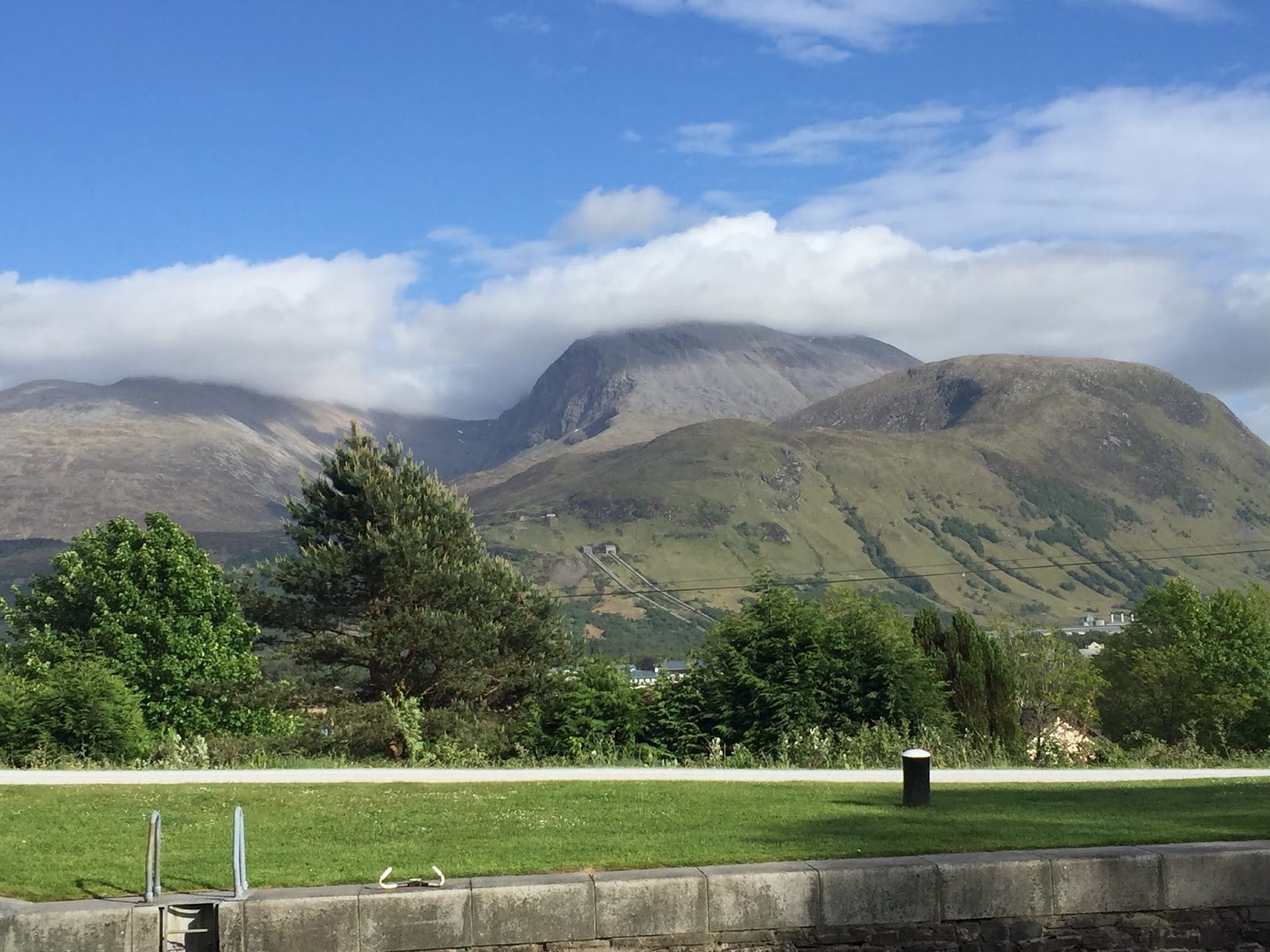
Ben Nevis


We tied up for the night at 1610 at Benavie.