Thursday, 25 April 2019

Fitting a tender, outboard and davits to MV Destiny

As with many things boat related, there is a need for compromise when choosing a tender. What type, size and material, what size of motor and how to secure it to your boat. I wanted something durable and of a suitable size to be able to ferry us ashore and able to carry all our victualing when we start our cruising in the Med. It also needed to be of a quality that would withstand the harsh UV environment. We also wanted it to be as light and able to withstand being pulled up onto a beach without damage. Having spoken with Neptune Marine regarding the largest practical size and after much consideration I decided on an AB Lamina 8AL - aluminium rib, 2.56m long and capable of carrying a 6HP motor and 4 people. We  would have liked something bigger but a compromise on size meant we could still have access to both sides of the bathing platform while not having the tender or outboard overhanging the sides of the boat. The choice of motor was simple in terms of size. The max the tender is rated for is 6HP. Having spoken to a number of suppliers we opted for the Suzuki DF6AS. In terms of davits, the space and shape of the bathing platform and transom limit the options. It was important for us to be able to remove the davits when not in use and after trolling the internet we opted for the Hurley H2O system. These are not cheap but Hurley seems to have the market covered and, as far as we could see, no-one else came close to their simple, practical, durable and sturdy design. All we had to do now was fit them!

This was not a straight forward job. The main reason being that a backing plate had to be fitted to support the davit brackets. However, the swim platform is hollow and the davits needed to be fitted 1 metre from the opening of the cavity. My arms are only 0.7 metres long and besides, access to the cavity is from under the master bed, where access is restricted by pipes, cables steering gear, ducting and a wood pillar that supports part of the bed. This looked close to impossible so I contacted Elling. They said this could be done and when I asked how, their helpful response was "we employ small people"! At least I knew it was possible. So with this in mind me and Bruce - my very helpful and practically minded friend whose favourite saying is "everything is doable" - set about finding a solution.


First we got some backing plates made up with the nuts welded on - bottom item in picture left. I then got a long piece of wood and drilled holes to fit the spacing on the nuts - top item in picture left.


This allowed us to secure the backing plate onto the wood and thread it into the cavity while lying on top the batteries and crammed into a very tight space. After a bit of giggling around the plates were fitted. No small people were used during the completion of this procedure.


The video should help you to visualise our predicament.


Davit fitting bolted in place with a healthy dose of sealant/adhesive applied.

Both plates fitted
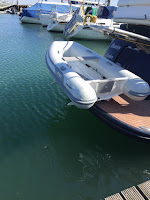
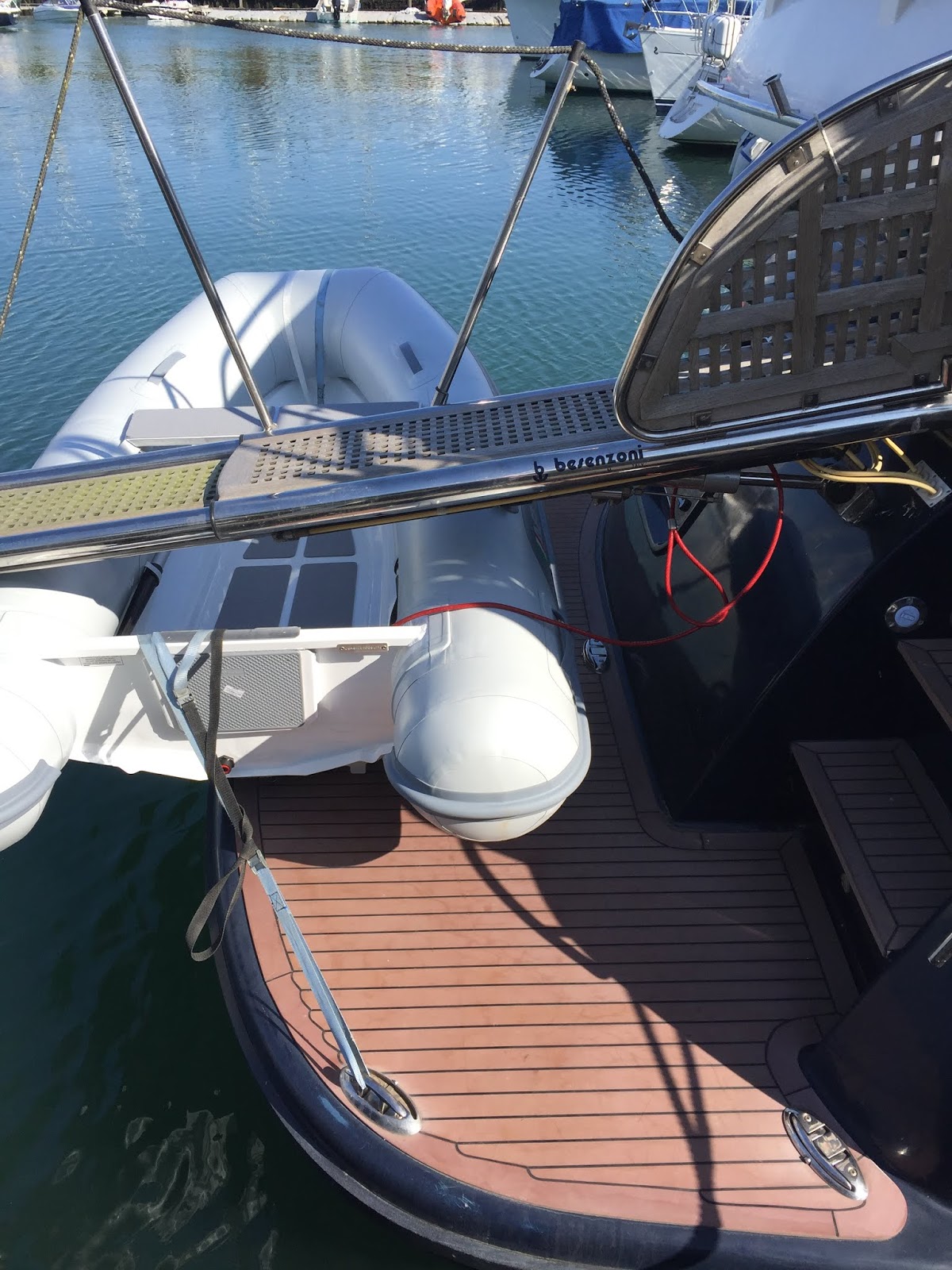
The new tender sitting on the Hurley H2O davits on the back ofMV  Destiny - an Elling E4


The final result with dingy sitting on davits.
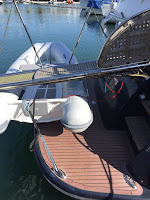


I had been warned that lifting the tender onto our swim platform which sits 450mm above the water was at the limit of what the davits are designed for.  If these young ladies can do it.......... (https://www.youtube.com/watch?v=JSoEBj9Px0A&feature=youtu.be). It proved to be very doable for me and Jane. If all else fails we could always revert to using the passerelle.

I'm now in the process of breaking/running-in the motor. Can't wait to see how it all performs once I'm allowed to wind her up past idle!


Friday, 12 April 2019

BREXIT- oh no!

Brexit
Like most people in the UK, and probably the EU, we have had enough of the interminable Brexit debates. However, for recreational boat owners Brexit poses its own challenges. The upshot of this is that we've been watching closely the numerous deadlines that have come and gone because leaving without a deal could have significant financial implications depending on where your boat is lying. As a result, we've been on standby to dash across to Holland should a "no deal" be on the cards. Let me explain.

Until recently the RYA (www.rya.org.uk), which has been doing a great job of lobbying government on behalf of the UK's boating community and has been my main source of information regarding the implications and consequences of Brexit, advised that information received from... 

"..the European Commission ... indicated that in the event of a no deal Brexit, boats lying in the EU27 at the time of Brexit would retain Union status and boats lying in the UK at the time of a no deal Brexit would lose Union status and have the status of UK goods."

This meant, in the event of a no-deal Brexit, that we would have to decide whether to have the boat in the UK and thereby keep its UK VAT-paid status but loose is EU tax-paid stays, or have the boat in the EU27 and keep EU tax status but loose the ability to keep the boat in the UK without having to repay tax. This caused some angst. We are planning to take the boat to the Med next year so it would be nice to have the tax paid there; however, we would probably bring the boat back to the UK to sell it when the time comes so it would be good to have tax paid here! Also, being a Dutch boat well suited to the European waterways we feel the ability to sell her in Northern Europe would be advantageous. We were caught between a rock and a hard place by EU bureaucracy

However, some sense has since prevailed and the RYA...

"...asked HMRC on behalf of RYA members, if boat owners would be able to bring them back to the UK without VAT and import duty (if applicable) becoming payable.


HM Government’s response is that it is still working towards a deal with the EU, but that plans have been made to replicate Returned Goods Relief (RGR) into domestic law in the event of a no deal. 
RGR allows those resident in the UK to return with their belongings (including pleasure boats) to the UK without paying customs duty or VAT as long as the items have not been changed since their departure and follow the guidance given in the Notice 236 Returned Good Relief.
The UK Government has undertaken that RGR will be available in respect of UK pleasure craft not moored in the UK on EU exit day. They may return to the UK after the exit and be subject to Returned Goods Relief as long as the person responsible has evidence that the VAT was paid on the purchase of the boat in either the UK or the EU."
In effect, this means that as long as the boat is in an EU27 country on the date we leave it should be viewed as having tax paid in the UK and the EU - RESULT! This is not the whole story and anyone affected by this should check with the RYA/government website for the additional details and developments.

The way Brexit talks are(n't) progressing, we should be well and truly ensconced in the Med by the time we leave! Watch this space.


Thursday, 11 April 2019

Date: April 2019

Seafood Extravaganza

The tides were right so we decided to take a trip to West Mersey and indulge in a seafood fest at the Company Shed.  Although the day was overcast, the wind was calm and we zipped along at just over 9 kts, assisted by about a knot of tide. There is no marina on Mersey Island so we moored on a buoy in the river and called Lady Grace - the ferry boat - skippered by a delightful and ebullient lady who took us ashore.

If you're ever in the area the Shed is a no frills establishment that serves amazing seafood. Oysters from the river, crab, lobster, mussels, prawns etc, all beautifully fresh and tasty. It's worthwhile taking your own bread and choice of beverage. The crab was one of the best I've ever tasted. Take a look at their website - (http://thecompanyshed.co) - it is correct. There is not ".uk" at the end.

We returned at low tide to our marina where they had been dredging the entrance. Just a as well. The spring tide left only 0.2m under the keel. A great day out. I'll get better at taking supporting pictures as the blog develops!

Sliding Roof - Doesn't!

I decided to open the roof to clean and lubricate the inflatable seal which had been sticking and preventing the roof from sliding forward. After a couple of unsuccessful attempts I could hear the motor running but got no movement of the roof. Diagnosis - the belt had broken. Having manually open the roof my fears were confirmed.


The new belt duly arrived from Elling


The belt is attached to the roof by a metal plate secured by the 4 bolts in the picture below. Belt tension is adjusted by a bolt in front of the wheel on the left of the picture. Access is limited which resulted in me making a bespoke 10mm spanner.


After cleaning the gully which houses the belt it was a fairly simple, but fiddly, job to fit the belt and adjust the tension.


All done and working perfectly.


Canvas Renovation
When we bought the boat we knew that the canvas covers surrounding the rear deck had to be re-stitched. UV had taken its toll and the seams were coming undone. Mother Nature had prevailed and an interesting green slim had evolved between the fabric layers where the stitching has failed.


Having removed the lacing that held the panels in place I took the panels home, cleaned them throughly and go to work with the sowing machine.

 I'm very pleased with the results.


Tender etc
We've decided what size and type of tender, outboard and davit system we will be using on Destiny and will report on this in a later blog.

Saturday, 16 February 2019

For our many followers (!!!) we will not be posting another blog until the end of March when we're planning a trip to the Netherlands. 

Tuesday, 12 February 2019

"The two happiest days of a person’s life — the day they bought the boat and the day they sold the boat"

It can certainly be the case that boat ownership is not always plain sailing: there are inevitably ups and down. However, I have always felt a pang of regret and sadness when passing on our previous boats to their new owners.

Our latest "happiest day" occurred at the end of August 2018 when we finally signed the paperwork on a 2007 Elling E4. The survey confirmed she was a fundamentally sound vessel with low hours that had been well cared for throughout her life. As always with boats, there were things that didn't work, things that needed to be upgraded and things we wanted to change. Following a brief handover by the broker we set off from her berth on the River Thames to her new home in Suffolk.


After a cautious start, we settled into enjoying the trip down the Thames to Limehouse marina. The Thames proved a delight and has real character - from quaint houses perched along the river banks to iconic buildings dominating the skyline all mixed with great scenery.
Tranqulity
No prizes for guessing who this belongs to

A  beautiful house boat


A famous landmark


As the sun began to dip below the horizon we entered Limehouse  marina where the helpful staff were there to guide us to our berth.

Limehouse is a great little marina with excellent access to the City, Canary Wharf and other parts of London. For it's location, it is good value and if you don't want to travel into town there are pubs and restaurants nearby, some with river views.  Sadly, our attempt to quaff a beer at The Grapes was thwarted since it was simply too busy to get in. We opted instead for a meal at The Narrows - a gastro pub outside the marina.


I would recommend a trip on the non-tidal Thames. There is lovely scenery and some beautiful homes to get you thinking that it might be worth coming out of retirement in order to afford one  - that thought soon faded!

The next morning we set off to catch the tide and head for Suffolk.  The lower part of the Thames is still very much a working river with lots of activity and some fairly large ships plying their wares.


                                                  This little beastie was moored in central London. Its 
                                                        tender was  about the same size as Destiny.


Sights of London


By late afternoon Destiny was tucked up in her new marina. The following day the weather had turned and the clear skies we had enjoyed turned to rain as we prepared to get lifted.


Now the work begins!


How did we come to own an Elling?

Having owned 2 boats since 2005, over the years our views on what we wanted to get from our next boat, and how we would use it, have evolved. We spent several years in the UK and then 7 years in the Med with our Trader 41+2 and loved it.

Our Trader in the Ionian
Being without a boat didn't sit well with me so we bought a nearly new Botnia Targa 35 which we kept in the UK. Much as we loved the Botnia it cemented our developing view that we wanted something more sedate with which we could cruise for extended periods in comfort and with enough room so as not to feel cramped.

Our Botnia Targa 35

Our requirements list included being a Cat A design (ocean-going), preferably single engine with a wing engine for back-up and preferably full displacement. I wanted a boat which was easy to work on and had appropriate access to all the mechanical and electrical systems. We also wanted the boat to have a reasonable range and to be of a well built and robust design which was equipped with all the comforts of home.

These requirements limited our choices since many motor boats, although claiming to be rugged and suitable for offshore passages, really aren't designed or built to stand up to the rigour of the open seas.

We looked at a number of options including our first choice of a Nordhavn 47. Sadly these are few and far between in UK/EU spec so we widened our search. Having looked at a number of Dutch steel boats we eventually had an offer accepted on a Diesel Duck based in the Med. The DDs are a niche design built in China. Sadly, on inspection, the paperwork didn't meet our expectations so we were back to the drawing board.

I'd heard of the Elling brand and seen them at boat shows; however, I'd never really seriously considered them thinking that the engine was too big and access to it and other systems would be too restricted.  Fortunately, I met the kind owners of an E3 in a local marina and they showed me around, eulogising all the time about how great their boat was.  This whet my appetite sufficiently to look further into the E4.  The rest, as they say, is history.

Destiny - the boat


To quote the manufacturer's blurb "The E-Series reach new levels of safety and luxury in contemporary yacht design, built from Twaron to the demanding CE Category A (Ocean) standard, that's as tough as a lifeboat!" To prove the point the company's owner underwent a capsize test - see the link below.

https://www.youtube.com/watch?v=bfhV87kppAE

Not that I would ever wish to put it to the test but it's a good publicity stunt!

DESTINY
Other that's self-righting ability which makes her well-suited for rougher waters, Destiny is equipped with an electrically operate aerial/radar mount facilitating an air draught of 3.45 metres which allows access to European canals down to the Med. Great flexibility for a boat of this size.

Vital Statistics

Interior
Cherry wood interior. 6 berths in 3 cabins - owner's cabin aft with a queen size island berth and en-suite, a mid-cabin with 2 bunks, and a forward cabin with 2 single berths. There is a further day head and shower off the saloon. Large saloon - seats 8 comfortably. The pilothouse has a helm seat and seating for 3 more. 3 wine cellars! TV lift in saloon. Wall hung TV in owner's suite. AM/FM radio + CD. 2 x Techma electric heads. Heated towel rails in heads. 220volt sockets throughout. Bug nets for all windows/hatches. Double glazing. Galley with electric oven and ceramic hob, microwave, large fridge/freezer and Miele washer/dryer.

Exterior
Outside there are 2 generous storage lockers/seats situated on a large after deck (approx 4 square metres) covered by a removable bimini.  Teak table. Decks are laid with flexi-teak. Outside hot and cold shower. Electrically operated hard top sliding roof with pneumatic seal.  Integrated seat on front deck for 2. Sun bed on front deck. Deck lights and courtesy lights. Hydraulic passarelle + remotes.

Technical
Main engine - Volvo Penta D6 435hp and 352 hours when bought
Wing engine - Volvo Penta D1 27hp and 55 hours when bought. Separate 100 litre fuel tank and drive.
Generator - Mastervolt 10 kVA and 190 hours when bought
Full reverse cycle AC - 40,000 BTU
1500 litres of fuel
Holding tank 150 litres
Water tank 850 litres
24 volt electrical system
25 kg Delta anchor plus 50 metres of 10mm chain
Chain counter
Bow and stern thrusters
1500W inverter
75A battery charger
420Ah domestic batteries
100Ah start batteries/stern thruster
Separate batteries and chargers for the generator and bow thruster
24 volt anchor windlass
Automatic engine fire system
Water alarm

Instruments
Rear view camera
Simrad plotter and radar - to be replaced
AIS
Wind, speed and depth data
Battery monitor
Yacht controller for easy mooring
Autopilot + remote
Compasses - electrical and analog
DSC radio
Handheld radio
Handhelp GPS
2 x barometers
Wempe Clock, hydrometer and thermometer

Safety
8 man liferaft
Lifejackets
EPIRBs
SART transponder
Navtex
Numerous fire extinguishers
Bow search light

Dimensions
LOA 14.95m
Draft 1.2m
Air draft 3.45m
Beam 4.25m
Max speed 16-18kts
Economic cruise up to 9kts